In this post we will learn some simple rules about voltage and current.
- Kirchhoff’s current law (KCL)
- Kirchhoff’s voltage law (KVL)
- The power consumed by a circuit device
Nodes, Branches and Loops of a Circuit
Node
Any circuit element connects between two nodes in the circuit. The path from one node to another through this element is called a branch of the circuit.
The point through which an circuit element is connected to the circuit is called node. It is better to say, node is a point where, terminal of two or more circuit elements are connected together. Node is a junction point in the circuit.


Branch
The branch of an electric circuit can be defined as the portion of the circuit between two nodes which can deliver or absorb energy.
As per this definition, the short circuit between two nodes is not referred as branch of electric circuit.

Loop
Loop is any closed path in the circuit formed by branches.
An electric circuit has multiple nodes. If you start at one node and travel through a set of nodes, returning to the starting node without crossing any intermediate node twice, you have completed a loop in the circuit.

Kirchhoff’s current law (KCL)
Statement: The total current entering a junction (node) is equal to the total current leaving the junction (conservation of charge).
Example: Consider a simple circuit junction (node A) where three branches meet as shown below.

The current in each branch is as follows:
- I1 = 5A entering the junction.
- I2 = 3A entering the junction.
- I3 = ? leaving the junction.
According to KCL:
I1 + I2 = I3
5A + 3A = 8A
So, the current leaving the junction I3 is 8A.

It follows that, for a series circuit (a bunch of two-terminal things all connected end-to-end), the current is the same everywhere.
Kirchhoff’s voltage law (KVL)
Statement: The sum of all electrical potential differences (voltages) around any closed loop in a circuit is equal to zero.
Practical Example:
Consider a simple closed-loop circuit consisting of a battery and two resistors:
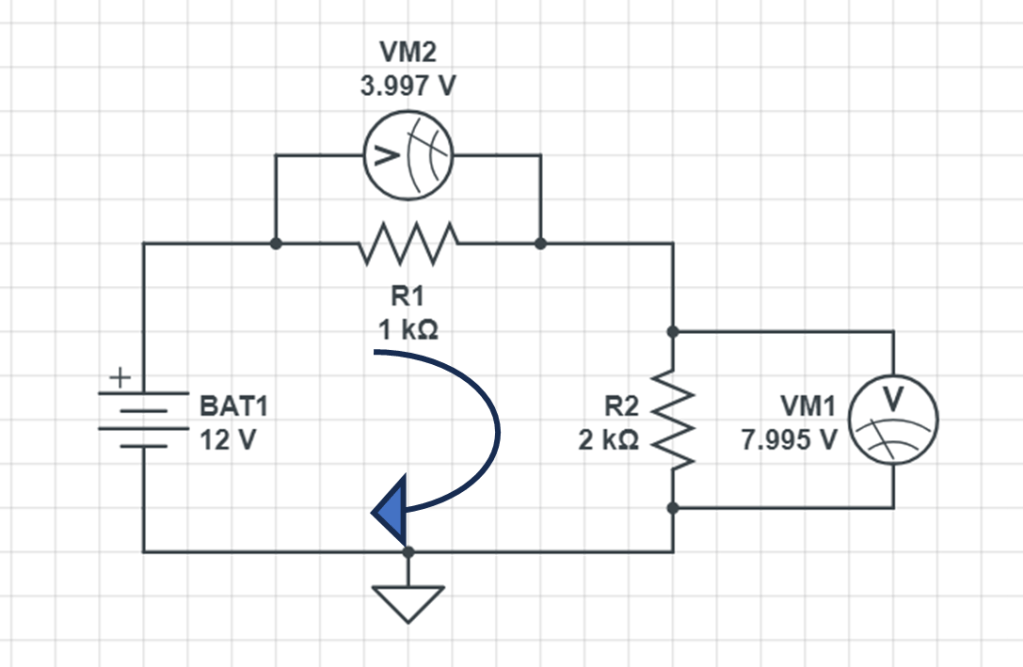
- Battery voltage VB = 12V
- Voltage drop across Resistor 1 VR1 = 4V
- Voltage drop across Resistor 2 VR2 = ?
According to KVL:
VB – VR1 – VR2 = 0
12V – 4V – VR2 = 0
VR2 = 8V
So, the voltage drop across Resistor 2 is 8V.
Note: There is potential drop across resistor. So we take it as -ve value.
The power consumed by a circuit device
The power (energy per unit time) consumed by a circuit device is:
P = V×I
This is simply (energy/charge) × (charge/time).
For V in volts and I in amps, P comes out in watts. A watt is a joule per second (1W = 1 J/s).
So, for example, the current flowing through a 60W lightbulb running on 120 V is 0.5 A.
Power goes into heat (usually), or sometimes mechanical work (motors), radiated energy (lamps, transmitters), or stored energy (batteries, capacitors, inductors).
Soon, when we deal with periodically varying voltages and currents, we will have to generalize the simple equation P = VI to deal with average power, but it’s correct as a statement of instantaneous power just as it stands.
References:
- The Art of Electronics by Paul Horowitz, Winfield Hill
- https://www.electrical4u.com/nodes-branches-and-loops-of-a-circuit/
Discover more from Embedded for All
Subscribe to get the latest posts sent to your email.
 Embedded for All